

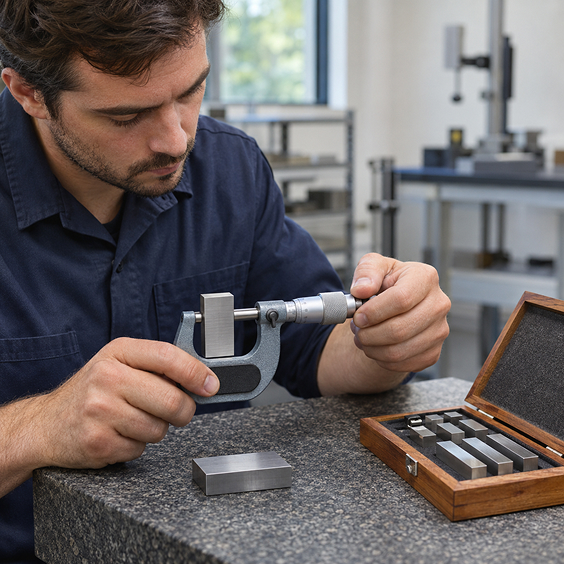
Start by identifying the instruments that need calibration, then choose a lab equipped to handle them. A good tools calibration lab in New England should cover the equipment you use, explain its results clearly, and be easy to work with year after year.
Calibration confirms that a tool still measures what it claims to measure. When a torque wrench, pressure gauge, or caliper drifts out of range, measurement errors can affect product quality and maintenance work. Often nobody notices until something fails an inspection or a part comes back wrong.
The right lab catches that drift early. Small errors are far easier to fix when they are found sooner rather than later.
Make Sure the Lab Covers Your Equipment
Different kinds of apparatus can be used in laboratories. Such instruments include calipers, torque wrenches, pressure gauges, and multimeters. There is a lot of bureaucracy involved in sending each type of atomic piece of furniture to different laboratories and some chances that some equipment may get lost. Thus, it would be better if one laboratory could manage all the calibration processes. Don’t forget to get a list of devices calibrated by the lab in question and compare it to your own.
These are the main categories to look for:
- Dimensioning tools include calipers, micrometers, gauges, and coordinate measuring machines
- Mechanical tools such as torque wrench, force gauge, durometer, and weight scale
- Electrical equipment includes multimeter, oscillator, power source, and signal generator
- Pressure and temperature devices including gauge, switch, and thermocouple
- Flow meter, gas detector, and other types of environmental or analytical instruments
Gaps in that list are worth noticing early. It is better to learn about them before you sign up than after your first audit.
Look for Experience With Your Industry
Calibration needs differ among industries. The needs of manufacturers pertain to size measurements while pressure and flow measurements are essential for chemical processors. As for laboratories, it has to deal with pH measurements as well as with UV/VIS spectrophotometers.
Calibration is critical for many industries, including aerospace, automotive, pharmaceuticals, manufacturing, energy, and telecommunications.
You should inquire whether the lab you have chosen to work with has sufficient experience in your area of business.
Check How the Lab Handles Safety-Related Instruments
When selecting a calibration provider in New England, its ability to provide calibration services for safety-related equipment should be the main criterion. Gas detectors are used to warn workers about hazardous fumes. Sound level meters are applied in investigations of noise pollution. Vibration analyzers allow technicians to detect malfunctioning equipment before breakdowns.
Should any device fail to do its work properly, it will give wrong information, which, in its turn, can cause wrong actions in the plant. In case your plant relies heavily on this kind of device, it’s necessary to make sure that the laboratory you are going to choose can do calibration not only of the devices but also update the frequency of the calibration.
Ask About Certificates and Records
Equipment calibration matters only if it has been confirmed to exist. Auditors and clients use documents for confirmation, so they expect to see certificates along with details about the process being used.
Gather up as much detail as you can about the certificates the vendors can issue along with the speed of obtaining them. Make sure the laboratory is certified to meet all the regulations of the industry. Inquire about device calibration records and whether they will be made available for you to use.
Some laboratories provide management systems and software for calibration purposes. This will allow you to control the dates of calibration, to keep records of calibrations and certificates in one place, making your job easier.
Compare In-Lab and Onsite Options
Certain tools are simple to pack and send. Some other types are bulky, permanently attached to their places, or too valuable to get rid of them for a long time. Inquire what apparatuses the laboratory calibrates in its facility and which can be calibrated in the laboratory.
Don’t forget to ask about practical matters as well. What is the process of helping yourself to the required tools? How long does the calibration take? Will it be possible to organize the work according to your production calendar?
Think About Location and Service Area
Distance matters more than most people expect. A tools calibration lab that serves your state is often easier to work with than one based far away. Check the lab’s service area before going any further. Some labs cover a single state. Others serve the whole region and beyond.
It also helps to ask what happens when a tool fails its check. Some labs offer repair and evaluation services, which can save you a second search for someone to fix the instrument.
Questions to Ask Before You Choose
Bring a short list to your first call. These five questions cover most of what you need to know:
- Which instrument types do you calibrate, and do they match my list?
- Do you calibrate in your lab, at my site, or both?
- What does the certificate show, and how fast will I receive it?
- How do you track due dates and equipment records?
- Which states do you serve, and what happens if a tool fails calibration?
Finding the Right Tool Calibration Partner
The best tools calibration lab in New England for your business is the one that fits your instruments, industry, and business schedule. Compare labs on those points, and ask for the details in writing.
At LAW Calibration, we calibrate dimensional, electrical, mechanical, pressure, temperature, flow, environmental, and analytical instruments for industrial customers.
We are based in Saco, Maine, and serve Maine, Vermont, New Hampshire, Massachusetts, Rhode Island, Connecticut, and other states across the Northeastern U.S. We offer both in-laboratory and onsite calibration services, along with calibration management systems and software.